

Chronic joint pain, persistent tendinopathy or a frozen shoulder that has not resolved for weeks: these are conditions that call for a precise, timely and medically supervised response. At Kensington International Clinic, we offer ultrasound-guided injections performed by a consultant radiologist, in a private setting in the heart of South Kensington.
Ultrasound allows the practitioner to visualise the target structures in real time, including joints, tendons and bursae, and to guide the needle with millimetre precision. The result is an injection delivered exactly where it needs to be, with greater accuracy and safety than a landmark-guided or blind injection.
Our
ultrasound specialist

Dr Ahmed Elowaidy, your consultant radiologist for ultrasound-guided injections
Dr Ahmed Elowaidy is a consultant radiologist at Guy’s and St Thomas’ NHS Foundation Trust, one of the UK’s most respected teaching hospitals, where he has practised since 2013. He holds the MBBCh, an MSc in Digital Radiology, the Fellowship of the Royal College of Radiologists (FRCR), the reference qualification for British radiologists and listed on the General Medical Council’s Specialist Register, and the European Diploma in Neuroradiology (EDiNR).
His expertise spans a particularly broad diagnostic range: abdominal and pelvic imaging, upper gastrointestinal, hepatobiliary and colorectal pathologies, gynaecological disorders, uroradiology, cross-sectional oncological radiology and neuroradiology. That deep familiarity with ultrasound interpretation, built over years of teaching-hospital practice, informs every interventional procedure he performs. His research interests include rectal cancer, hepatobiliary disease and upper gastroenterology.
Consulting Dr Elowaidy for an ultrasound-guided injection means benefiting from the clinical eye of a consultant radiologist: precise real-time image reading, clinical decisions grounded in direct tissue observation, and injection technique performed with the rigour characteristic of a leading imaging specialist.
What is an ultrasound-guided injection and why is it more effective?
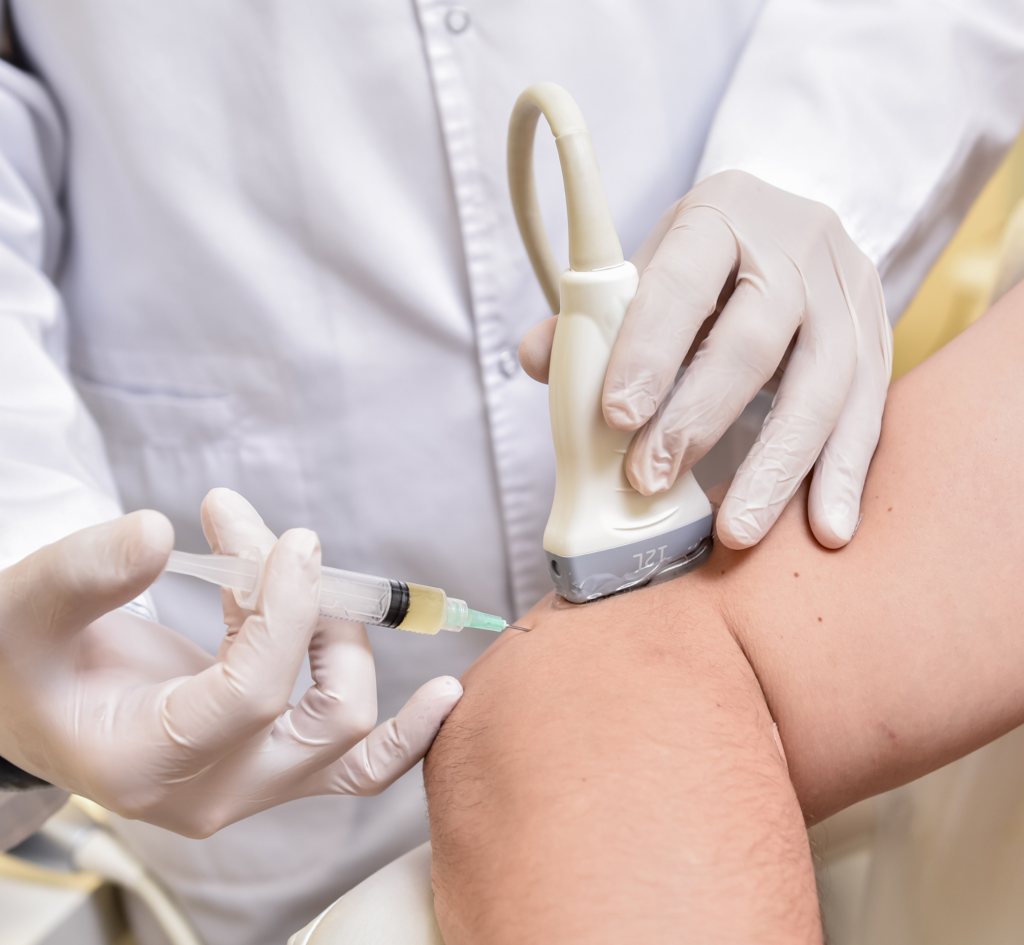
An ultrasound-guided injection is a procedure in which the practitioner uses an ultrasound transducer placed on the skin to visualise, in real time on a monitor, the targeted tissues and the path of the needle. Unlike a blind injection, which relies solely on surface anatomical landmarks, an ultrasound-guided injection ensures that the substance is deposited precisely at the intended site.
The benefits of ultrasound guidance are well documented in the medical literature:
- Greater accuracy: for intra-articular knee injections, accuracy improves from 75% to 100% with ultrasound guidance.
- More lasting relief: studies show that patients who receive hyaluronic acid injections under ultrasound guidance require joint replacement surgery significantly less often than those treated without guidance.
- Enhanced safety: real-time visualisation reduces the risk of contact with unintended structures such as nerves and blood vessels.
- Less discomfort: the injection is faster and more precise, which reduces the duration of the procedure and the degree of tissue trauma.
Injections available at Kensington International Clinic
Our clinic offers a comprehensive range of ultrasound-guided injections, tailored to the nature and stage of your condition. Dr Elowaidy determines during your consultation which substance is most appropriate for your situation.
Corticosteroid injection (cortisone)
Corticosteroid injection is the most widely used treatment for reducing joint or peri-articular inflammation. It works by dampening the local inflammatory response, relieving pain and improving mobility. It is particularly indicated for frozen shoulder (adhesive capsulitis), tendinopathies, carpal tunnel syndrome, De Quervain's tenosynovitis, trigger finger and thumb, and flares of osteoarthritis.
Most patients tolerate this injection very well. A steroid flare, a transient increase in pain in the 48 hours following the injection, is possible but short-lived.
Hyaluronic acid injection (viscosupplementation)
Hyaluronic acid is a substance that occurs naturally in the synovial fluid of joints. Its injection aims to restore the lubricating and shock-absorbing properties of the joint fluid, which are reduced by osteoarthritis or wear. It is primarily indicated for knee and hip osteoarthritis in patients who wish to preserve their mobility while delaying the need for surgery.
The preparations used include Ostenil and Durolane, two viscosupplements with an established evidence base in the clinical literature.
High volume injection (HVI)
High volume injection is indicated for tendinopathy of the large lower limb tendons, particularly the Achilles and patellar tendons. The procedure involves injecting a relatively large volume of fluid at the interface between the tendon and the adjacent fat pad, in order to mechanically disrupt pathological scar tissue and restore normal tendon glide.
Hydrodilatation
Hydrodilatation is a procedure reserved for severe adhesive capsulitis (frozen shoulder). It involves injecting a volume of fluid into the glenohumeral joint to mechanically stretch the contracted joint capsule, enabling a progressive recovery of range of motion. It can be an effective alternative to surgery or manipulation under anaesthetic in selected cases.
Prolotherapy
Prolotherapy uses injections of concentrated glucose solution, typically diluted with a local anaesthetic. This solution acts as an irritant agent, triggering a controlled local inflammatory response that stimulates healing in lax ligaments. It is indicated in chronic ligament instability.
If you are unsure whether your situation warrants an appointment, call our reception team: they will advise you honestly.
Conditions treated with ultrasound-guided injections
Ultrasound-guided injections are indicated across a wide range of musculoskeletal and tendon conditions:
- Shoulder : Adhesive capsulitis (frozen shoulder), rotator cuff tendinopathy, subacromial bursitis, calcific tendinopathy (barbotage), glenohumeral osteoarthritis.
- Knee : Knee osteoarthritis (gonarthrosis), prepatellar bursitis, patellar tendinopathy, joint effusion, Baker’s cyst (popliteal cyst).
- Hip : Hip osteoarthritis (coxarthrosis), trochanteric bursitis.
- Ankle and foot : Achilles tendinopathy, plantar fasciitis, subtalar osteoarthritis.
- Wrist and hand : Carpal tunnel syndrome, De Quervain’s tenosynovitis, trigger finger and thumb, osteoarthritis of the small joints of the hand.
What to expect during your appointment?
The consultation and the injection take place during a single appointment, with no need for a separate referral or prior imaging at another facility.
On arrival, Dr Elowaidy begins with a clinical assessment of your condition, followed by an ultrasound examination of the affected area. This examination confirms the diagnosis, evaluates the state of the anatomical structures (joint, tendon, bursa) and identifies the optimal injection site.
If an injection is indicated and clinically appropriate, it is performed during the same appointment, under real-time ultrasound guidance. The procedure itself takes only a few minutes. A rest period of approximately 30 minutes after the injection is recommended before leaving the clinic.
A report of the examination and the procedure performed is provided to you at the end of your appointment. With your consent, it can be forwarded to your GP.
If a local anaesthetic has been administered, it is advisable not to drive for several hours following the procedure.
fees for ultrasound-guided injections at Kensington International Clinic
Kensington Clinic publishes its fees transparently.
Type of injection | Site(s) | Fee |
Corticosteroid (cortisone) | 1 site | £320 |
Corticosteroid (cortisone) | 2 sites | £430 |
Hyaluronic acid (Ostenil / Durolane) | 1 site | £430 |
Hyaluronic acid (Ostenil / Durolane) | 2 sites | £530 |
Booking: a prepayment of £70 is required at the time of booking. The remaining balance is settled on the day of the appointment.
Cancellation policy:
- More than 72 hours in advance: full refund
- Between 48 and 72 hours: the £70 prepayment is retained
- Less than 48 hours: the full consultation fee is charged
Some private health insurance policies, particularly expatriate cover, may reimburse part or all of the cost of these procedures. We recommend checking your cover directly with your insurer before your appointment.