

The reference treatment for saphenous varicose veins
Endovenous laser ablation, or EVLA, has become within two decades the reference treatment for saphenous varicose veins, replacing traditional surgical stripping in the vast majority of cases. At Kensington International Clinic, this procedure is performed by Professor Usman Jaffer, consultant vascular surgeon at Imperial College NHS Trust, Fellow of the Royal College of Surgeons and holder of a Masters in Medical Ultrasound.
EVLA offers three decisive advantages over traditional surgery: it is performed under local anaesthesia on a day-case basis, with no surgical incision, and recovery allows a return to daily activities within days. Long-term clinical outcomes are equivalent to, and often better than, those of stripping, with a reduced risk of recurrence.
What is endovenous laser ablation?
Endovenous laser ablation is a minimally invasive endovascular technique that thermally occludes a diseased vein from the inside, using a laser fibre introduced through a skin puncture under ultrasound guidance. The heat emitted by the fibre causes the vein wall to contract and seal permanently; the closed vein is then gradually reabsorbed by the body over the following months.
In practice, EVLA replaces the older stripping surgery (which physically removed the diseased vein through incisions at the groin and knee) with a minimally invasive procedure without incisions. No visible scars, no hospital stay, no prolonged time off.
The procedure primarily targets the great saphenous vein and the small saphenous vein, the two main superficial venous axes whose insufficiency is responsible for most varicose veins.
How does an EVLA procedure work?
The procedure is performed as a day case at our Kensington premises. Total time at the clinic is around 45 to 60 minutes, including 20 to 30 minutes of active laser treatment.
Step 1, ultrasound mapping.
Ahead of the procedure, the venous network is mapped during the duplex scan. This stage determines which axis to treat, which collaterals may need later care and the optimal treatment strategy.
Step 2, tumescent anaesthesia.
On the day, local "tumescent" anaesthesia is infiltrated along the length of the vein to be treated. This technique, a hallmark of modern phlebology, numbs the area, protects surrounding tissues from laser heat and improves fibre contact with the vein wall.
Step 3, insertion of the laser fibre.
A micro-puncture (not an incision) allows a catheter to be introduced into the diseased vein under ultrasound guidance. The laser fibre is then positioned precisely at the upper end of the segment to be treated.
Step 4, thermal ablation.
The fibre is slowly withdrawn while emitting laser energy. The vein closes as the fibre passes. The operator controls the procedure in real time using ultrasound imaging.
Step 5, post-procedure compression.
A compression stocking is fitted immediately and must be worn according to a specific protocol for several weeks.
The patient leaves the clinic on foot, a few minutes after the procedure.
Is EVLA right for you? Indications for treatment
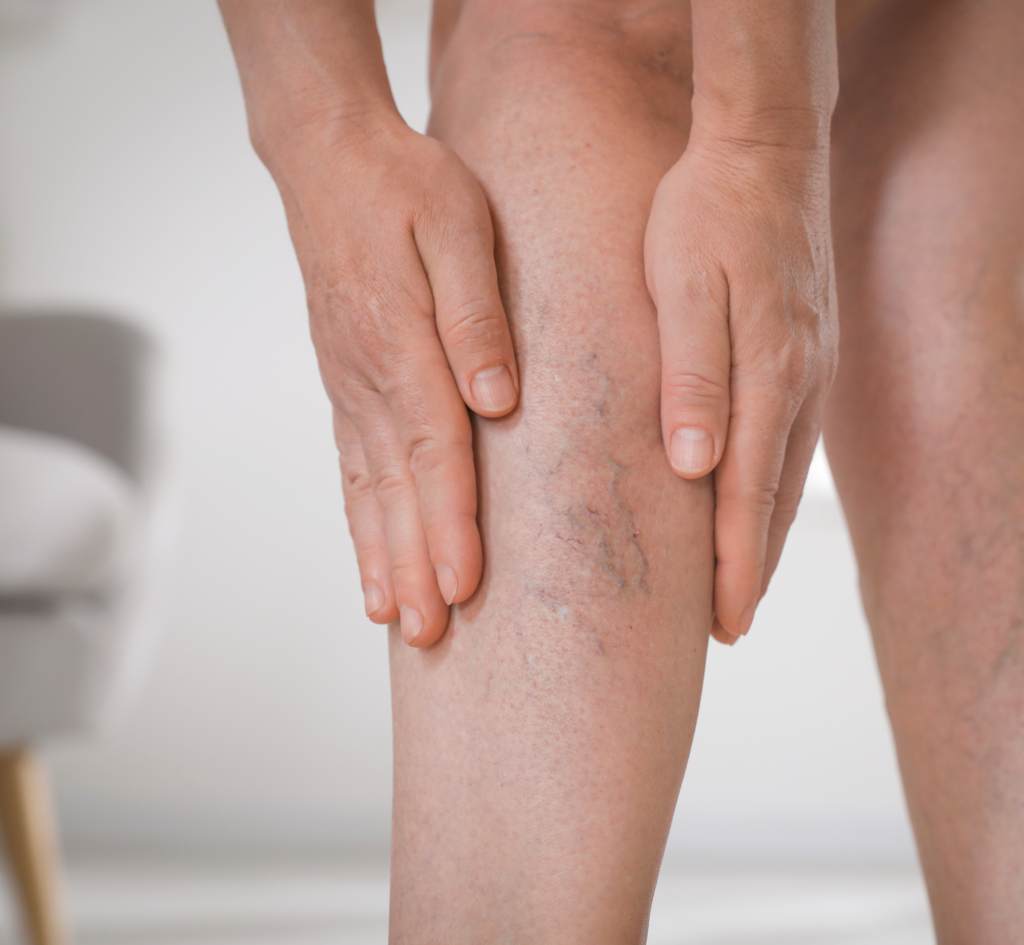
EVLA is indicated in the management of varicose veins caused by superficial venous insufficiency, confirmed by a duplex scan. The most frequent indications are:
- Great saphenous vein insufficiency, the most common venous axis involved in leg varicose veins
- Small saphenous vein insufficiency, rarer but well addressed by EVLA
- Symptomatic varicose veins (heaviness, pain, night cramps, end-of-day swelling)
- Complicated varicose veins (venous ulcer, stasis dermatitis, previous superficial vein thrombosis)
- Recurrent varicose veins after surgical stripping or previous treatment failure
- Aesthetic concerns linked to visible truncal varicose veins, when duplex confirms significant reflux
Some clinical situations may contraindicate EVLA or require technique adjustments: recent deep vein thrombosis, current pregnancy, local skin conditions, atypical venous anatomy. These are assessed during the initial consultation.
EVLA vs surgical stripping: why choose laser?
Criterion | EVLA | Surgical stripping |
Anaesthesia | Local (tumescent) | General or spinal |
Hospital stay | Day case, a few hours | 1 to 2 nights |
Scars | None (micro-puncture) | Groin + knee incisions |
Return to activity | 2 to 3 days | 2 to 3 weeks |
Post-op pain | Moderate, managed with simple analgesics | Significant, heavier pain protocol |
5-year recurrence rate | 5 to 10% | 20 to 25% |
Risk of extensive bruising | Low | High |
EVLA is now recommended as first-line treatment by most international professional bodies (NICE in the UK, ESVS across Europe) for the management of symptomatic saphenous varicose veins.
Your EVLA pathway at Kensington International Clinic
Your care is organised in three distinct stages.
- Initial consultation and duplex scan. Dr Wissem Abdellaoui performs a complete duplex scan to map your venous network and confirm the indication. This step is essential: no EVLA is scheduled without prior mapping.
- EVLA procedure. Professor Usman Jaffer performs the procedure at our clinic, following the protocol described above. The full pathway on the day (arrival, preparation, procedure, short recovery) takes around two hours. You leave walking, accompanied if possible.
- Post-procedure follow-up. A first duplex check is carried out at one month to confirm complete closure of the treated vein. Follow-up sclerotherapy sessions for collateral veins may be offered later if needed, for optimal aesthetic outcome.
How much does endovenous laser ablation cost in London?
Service | Fee |
Duplex scan and phlebology consultation (mandatory prerequisite) | £450 |
Endovenous laser ablation (EVLA), unilateral | £2,600 |
Endovenous laser ablation (EVLA), bilateral | £4,900 |
One-month follow-up duplex | £390 |
Additional sclerotherapy for collaterals (per session) | £250 |
EVLA fees in London private clinics typically range from £2,500 to £3,500 per leg, depending on anatomical complexity and the surgeon. Our £2,600 fee for unilateral EVLA places Kensington Clinic at the lower end of the premium private market, while offering a clinical platform and surgical expertise at teaching-hospital level.
Book an EVLA procedure in London
Kensington International Clinic is located at 2 North Terrace, London SW3 2BA, six minutes’ walk from South Kensington station. Vascular consultations and procedures are delivered in English, Urdu, Punjabi and Hindi by Professor Jaffer, and in French, English and Arabic by Dr Abdellaoui.
To book your pre-procedure vascular check-up and EVLA procedure, call us on 020 7589 9321, email contact@kic.london, or use our online booking system.
Insurance cover: most international private health insurers (Bupa, Cigna, AXA, Allianz, WPA) cover EVLA, with or without excess. We recommend checking your cover with your insurer before the initial consultation.
Recovery and aftercare
Recovery after EVLA is one of its major advantages: most patients walk immediately, return to sedentary work within 2 to 3 days and resume moderate physical activity within 10 to 15 days.
Normal post-operative course:
- Sensation of tightness along the treated vein, peaking around day 7
- Localised bruising, usually moderate, resolving within 2 to 3 weeks
- Moderate pain, well controlled by paracetamol or anti-inflammatory drugs
- Compression stocking worn for 2 to 4 weeks per protocol
When to contact the clinic:
- Severe, sudden or unusual pain
- Significant calf swelling with tenderness on palpation
- Extensive redness or fever
- Significant bleeding at the puncture site
A first duplex check at one month confirms that occlusion of the treated vein is complete and durable.