

Venous conditions affect women far more than men, at every stage of life: pregnancy, hormonal contraception, menopause, hormone replacement therapy. At the Kensington International Clinic in London, we take care of the full spectrum of venous conditions of the legs, from the simple cosmetic treatment of fine thread veins to the management of varicose veins associated with chronic venous insufficiency.
Our medical team carries out diagnostic Duplex scanning and offers minimally invasive treatments tailored to each case, within a high-end private setting.
Our
specialist consultants
Vein care at the Kensington International Clinic is delivered by a medical team of two specialists.

Dr Wissem Jalila Abdellaoui
Dr Wissem Jalila Abdellaoui is a vascular medicine consultant. Trained at the French school of angiology, she conducts the entire diagnostic pathway and all minimally invasive treatments at our private clinic. She performs the Duplex scan herself during the consultation, maps the venous network, sets the therapeutic indication and carries out micro-sclerotherapy and ultrasound-guided foam sclerotherapy.
She consults in both French and English.

Pr Usman Jaffer
Pr Usman Jaffer is our consultant vascular surgeon. He takes over cases that require surgical management: complex true varicose veins, recurrences, anatomies not accessible to minimally invasive techniques. His NHS background and his expertise in endovenous laser ablation bring the team its British clinical reference standard.
Spider veins, thread veins, leg veins… how to tell them apart?
“Spider veins”, “thread veins” and “leg veins” are not the same thing. Here is how to distinguish them:
- Thread veins: the finest visible superficial veins, under 1 millimetre in diameter. Red, blue or purple, they form fine lines or small ramifications on the skin of the thighs, calves and ankles. They are essentially a cosmetic concern. The reference treatment is micro-sclerotherapy, very fine injections of a liquid sclerosing agent, performed as an outpatient procedure over several sessions;
- Spider veins: slightly larger (1 to 3 millimetres), they appear as a star or tree-like pattern radiating from a central vein. They are sometimes associated with a warm sensation or a marked aesthetic concern. Treatment combines micro-sclerotherapy and, depending on calibre, ultrasound-guided foam sclerotherapy;
- Leg veins: an umbrella term covering fine thread veins, reticular veins (3 to 5 millimetres, often blue-green, visible as a network beneath the skin) and true varicose veins (prominent, tortuous veins over 5 millimetres). This last category requires thorough Duplex scan evaluation, as it almost always reflects underlying venous insufficiency that must be treated before or alongside any cosmetic procedure.
The initial consultation at our French-speaking private clinic in London is what allows us to make the correct diagnosis, identify any venous reflux that is not visible to the eye, and build a personalised treatment protocol.
Why are women more exposed to venous disorders?
Epidemiological studies all point the same way: women are significantly more affected than men by varicose veins, spider veins and venous insufficiency. Several biological factors explain this female predominance:
Female sex hormones (oestrogen and progesterone) act directly on the venous wall. They relax the connective tissue that supports the vein and alter the tone of the vascular smooth muscle. As a result, veins dilate more easily and the valves that prevent blood from flowing back down towards the foot become less efficient;
Hormonal fluctuations throughout life (menstrual cycle, successive pregnancies, hormonal contraception, perimenopause, menopause, HRT) expose women to repeated peaks that weaken the venous network over time;
The growing weight of the uterus during pregnancy compresses the iliac veins and the inferior vena cava, slowing venous return from the lower limbs. The increase in circulating blood volume (around +40% by the third trimester) further raises pressure in the leg veins;
In most cases, patients report a family history of varicose veins, phlebitis or venous insufficiency. This genetic background typically reveals itself when a hormonal event occurs.
Pregnancy and varicose veins: understanding and anticipating
Pregnancy is one of the most common triggers of varicose veins in women. Nearly one pregnant woman in two develops or sees worsening spider or varicose veins during pregnancy, particularly from the second trimester onwards.
Why?
Three factors combine:
- Hormonal impregnation (oestrogen and progesterone) relaxes the venous wall;
- Blood volume increases significantly to support foetal development;
- The uterus progressively compresses the large abdominal veins, slowing venous return.
Should you be concerned?
Most varicose veins that appear during pregnancy regress spontaneously within three to six months after delivery. Some, however, persist and may worsen with each subsequent pregnancy. A review consultation is recommended in the months following birth to assess the venous network and decide, if needed, on treatment.
Situations to flag to your doctor immediately
Significant calf pain, localised warm redness, asymmetrical swelling in one leg, or unusual shortness of breath are potential signs of deep vein thrombosis or pulmonary embolism and require immediate medical assessment.
The thromboembolic risk is multiplied during pregnancy and in the postpartum period.
Preventive measures
During pregnancy, care is primarily preventive:
- Wearing medical-grade compression stockings
- Maintaining gentle regular physical activity (walking, swimming)
- Elevating the legs when resting
- Adequate hydration
- Avoiding prolonged standing and direct heat on the legs
Contraceptive pill, menopause and hormone replacement therapy:
what impact on the veins?
Any significant hormonal variation can affect a woman’s venous health. Here is what to know.
Hormonal contraception
Combined oral contraceptives (oestrogen + progestogen) slightly increase the risk of venous thromboembolism, particularly during the first year of use and in patients with thrombophilia (a clotting disorder), a family history of phlebitis or concurrent smoking. In patients predisposed to varicose veins, the pill can also trigger or worsen spider veins.
Perimenopause and menopause
The progressive drop in oestrogen around menopause alters the structure of the venous wall. Many women notice at this stage the onset or acceleration of spider veins on the legs and thighs.
Hormone replacement therapy
HRT, prescribed to relieve menopausal symptoms, can also affect the venous system. The risk varies depending on the route of administration, dose and duration of treatment. In patients with a history of varicose veins or thrombosis, a vascular assessment is recommended before starting HRT, and regular monitoring is advisable for the duration of treatment.
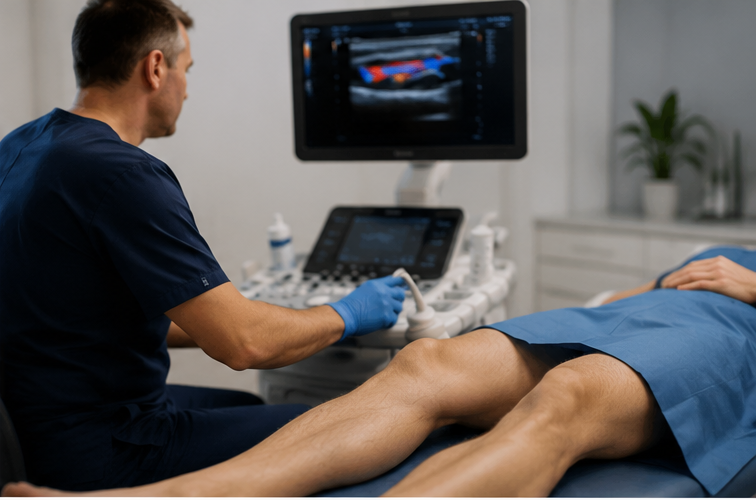
Varicose and spider veins treatments offered at our private clinic
Depending on the diagnosis made by the specialist, several minimally invasive treatment options can be offered:
- Micro-sclerotherapy: it is a very fine injection of a liquid sclerosing agent. Outpatient procedure, no anaesthesia, no downtime. Several sessions spaced a few weeks apart are generally required for an optimal aesthetic result;
- Ultrasound-guided foam sclerotherapy: indicated for medium-calibre varicose veins and reticular veins, as well as for certain true varicose veins where surgical ablation is not the best option. A foam sclerosing agent is injected under ultrasound guidance, allowing precise treatment of veins that are not visible at the surface;
- Endovenous laser ablation (EVLA): the treatment of choice for true varicose veins of the great or small saphenous vein caused by reflux. A laser fibre is introduced into the vein under tumescent local anaesthesia and ultrasound guidance. Minimally invasive, outpatient, rapid recovery;
- Vascular surgery: for complex cases (recurrences, anatomies not accessible to minimally invasive techniques), Pr Usman Jaffer provides surgical care within the Kensington International Clinic.